It starts with an email. A procurement contact at one of your larger clients sends over a form (sometimes a few questions, sometimes a 50-page spreadsheet) asking about your carbon emissions, energy use, or sustainability practices. If you have never dealt with this before, it can feel completely out of left field. You are a small business. Why does any of this apply to you?
The short answer is that it does not apply to you directly, but it very much applies to your clients. And that distinction matters a lot.
What is driving this: Scope 3 emissions
Under the international standard for carbon accounting, the Greenhouse Gas (GHG) Protocol, companies measure their emissions in three categories. Scope 1 covers what they burn directly (fuel in their own vehicles, for example). Scope 2 covers the electricity they buy. And Scope 3 covers everything else, including the emissions produced by their suppliers.
That last category is the one that changes everything for small businesses. For many large companies, Scope 3 emissions represent the vast majority of their total carbon footprint.
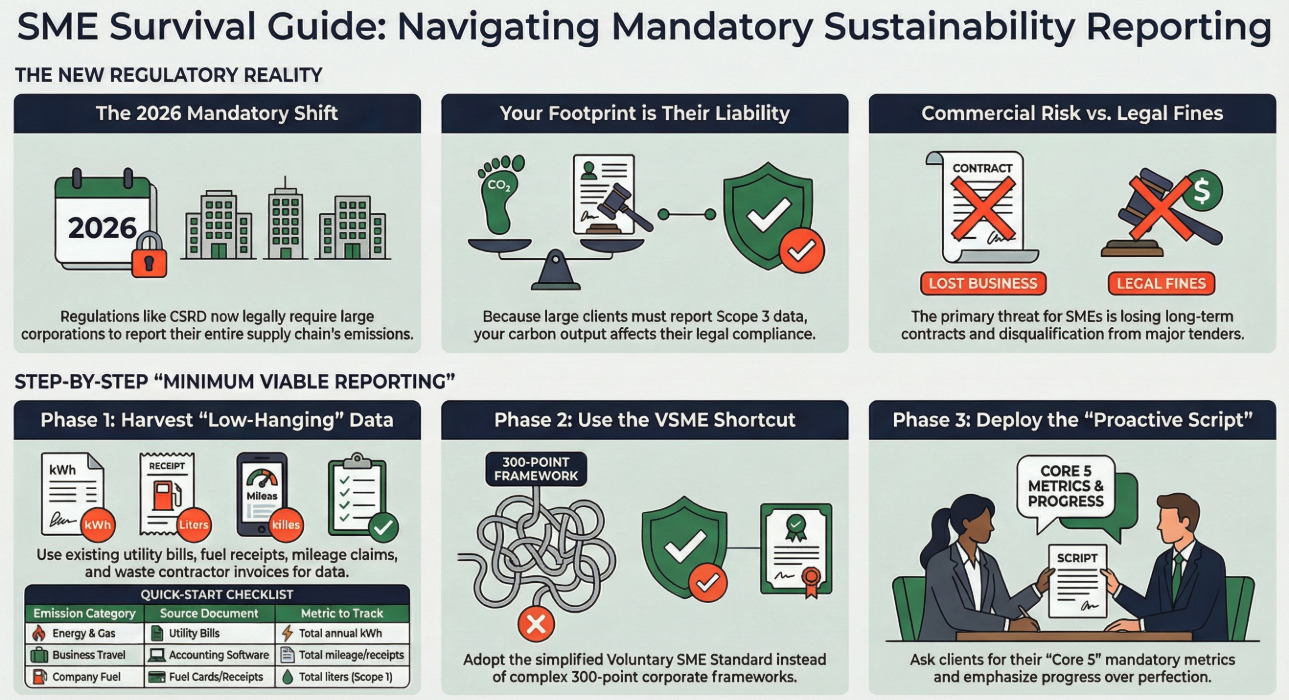
This means a large company simply cannot reach its climate targets without data from its suppliers. Your energy bills, your fuel use, your waste: all of that feeds into your client's numbers. Your footprint has effectively become part of their legal liability.
The regulation behind it
As of 2026, this is no longer just a voluntary commitment. Under the EU Corporate Sustainability Reporting Directive (CSRD), large companies are legally required to report on their full supply chain emissions. The CSRD was transposed into Irish law in July 2024, and while recent updates (the so-called "Omnibus" proposals) have pushed some deadlines back by two years, the largest buyers in the economy (around 250 entities in Ireland) are already reporting or preparing to do so.
Complementing this is the Corporate Sustainability Due Diligence Directive (CSDDD), which requires large companies to actively identify and address environmental impacts across their value chains. This goes beyond asking for a number; clients may now ask for evidence that you have a plan to reduce your emissions over time.
The key point for small businesses is this: even though you are not directly in scope for these regulations, you are very much in scope for the companies that are.
Suppliers providing credible carbon data are increasingly securing preferred status and longer contracts, while those unable to provide such data face increased scrutiny or exclusion from procurement processes.
EcoHedge, How SMEs Use Carbon Data to Win ESG Contracts
The real risk for small businesses
The risk is not a fine or a legal penalty. It is a commercial one. Large clients are now scoring their suppliers on sustainability data as part of their procurement processes. If you cannot provide basic information, you risk being dropped from a tender, losing a contract renewal, or simply being seen as a high-risk partner.
There is also a financing angle. Irish banks are increasingly linking access to green loans (and in some cases interest rates) to whether a business can demonstrate a measurable carbon footprint and a clear direction of travel. A small data pack can make a real difference when you next go looking for credit.
How to respond: minimum viable reporting
The good news is that you do not need a sustainability department to handle this. The goal is to provide accurate, defensible data, not produce a 300-page report.
Most of the data you need already exists in your business. You just need to pull it together: your total annual kWh from utility bills, the litres of petrol or diesel used in company vehicles, mileage claims or travel receipts from your accounting software, and the weight or volume of waste on your contractor's invoices. This activity-based data is more accurate than estimates, and it is the kind of information most clients genuinely need.
Rather than filling out a different spreadsheet for every client that asks, you can anchor your reporting to a single standard: the Voluntary SME Standard (VSME), developed by the European Financial Reporting Advisory Group (EFRAG). It covers the core data most clients need: energy, emissions, waste, workforce, and governance basics. A key provision in the 2026 Omnibus agreement means that large companies subject to the CSRD cannot demand more data from small suppliers than what is defined within the VSME. This effectively gives you a protective shield. If a client sends a 50-question form, you are entitled to respond: "We report in line with the EU VSME standard."
An important note for micro-businesses: the Basic Module of the VSME does not require Scope 3 reporting. You only need to cover your own direct operations: Scope 1 and 2. That is a significant simplification that most small firms can manage without specialist help.
Converting your records into carbon figures does not require paid software. The SME Climate Hub offers a free Business Carbon Calculator for small businesses. In Ireland, tools like Green Ledger are designed to automate SEAI compliance by scanning utility bills and applying Irish-specific emission factors.
How to respond to that questionnaire
When a client sends you a long sustainability form, here is a practical way to handle it.
First, ask which fields are actually mandatory. Many long questionnaires have only a small number of truly required fields (often just energy and travel data). Ask your contact directly: which metrics do you actually need for your Scope 3 report this year?
Second, state your methodology. Something like: "Data collected using [tool name], based on the EU VSME framework; baseline year 2025/26." This tells the client you are following a recognised standard, not guessing.
Third, show progress rather than perfection. If you do not yet have a figure for a particular category, do not leave it blank. Write: "Currently establishing data collection process; expected by Q3." This marks you as a low-risk, forward-moving supplier, which is often all a client needs to see.
Other support worth knowing
If you want to go further than just answering a questionnaire, there is real support available to help you measure and reduce your footprint.
Get started
The Climate Toolkit 4 Business is a free online tool from the Irish government. It walks you through a straightforward estimate of your business footprint across energy, transport, and waste — a solid first step before you touch any formal framework.
Explore your energy options
The SEAI Energy Audit Voucher offers €2,000 to cover a professional energy audit for any business spending more than €10,000 a year on energy. If energy is your biggest source of emissions (as it is for most small businesses), this is where the clearest savings are.
Go deeper
The Green for Business programme from the Local Enterprise Office provides free access to a green consultant for businesses with up to 50 employees. For businesses ready to go further, the GreenStart grant from Enterprise Ireland covers 80% of a seven-day sustainability consultancy, up to €5,000.