A lot of small business owners stay quiet about sustainability because they feel they have not done enough. But silence is not the answer, especially when customers are actively looking for businesses they can trust.
Small businesses have a real advantage here. You are close to your suppliers, your production, your customers. You can explain what you are doing in a way that a large corporation never could. The key is to be honest about where you are, not where you wish you were.
The biggest trap: vague language
Words like "eco-friendly," "green," "natural," or "sustainable" sound good, but they are almost meaningless without context. Under the EU's Empowering Consumers for the Green Transition Directive (effective September 2026), these generic claims will be banned unless backed by recognised evidence.
The fix: be specific. If you cannot explain why something is green in one sentence, do not use the label.
Here is a quick comparison:
The rule: say what you actually did, not what you aspire to be.
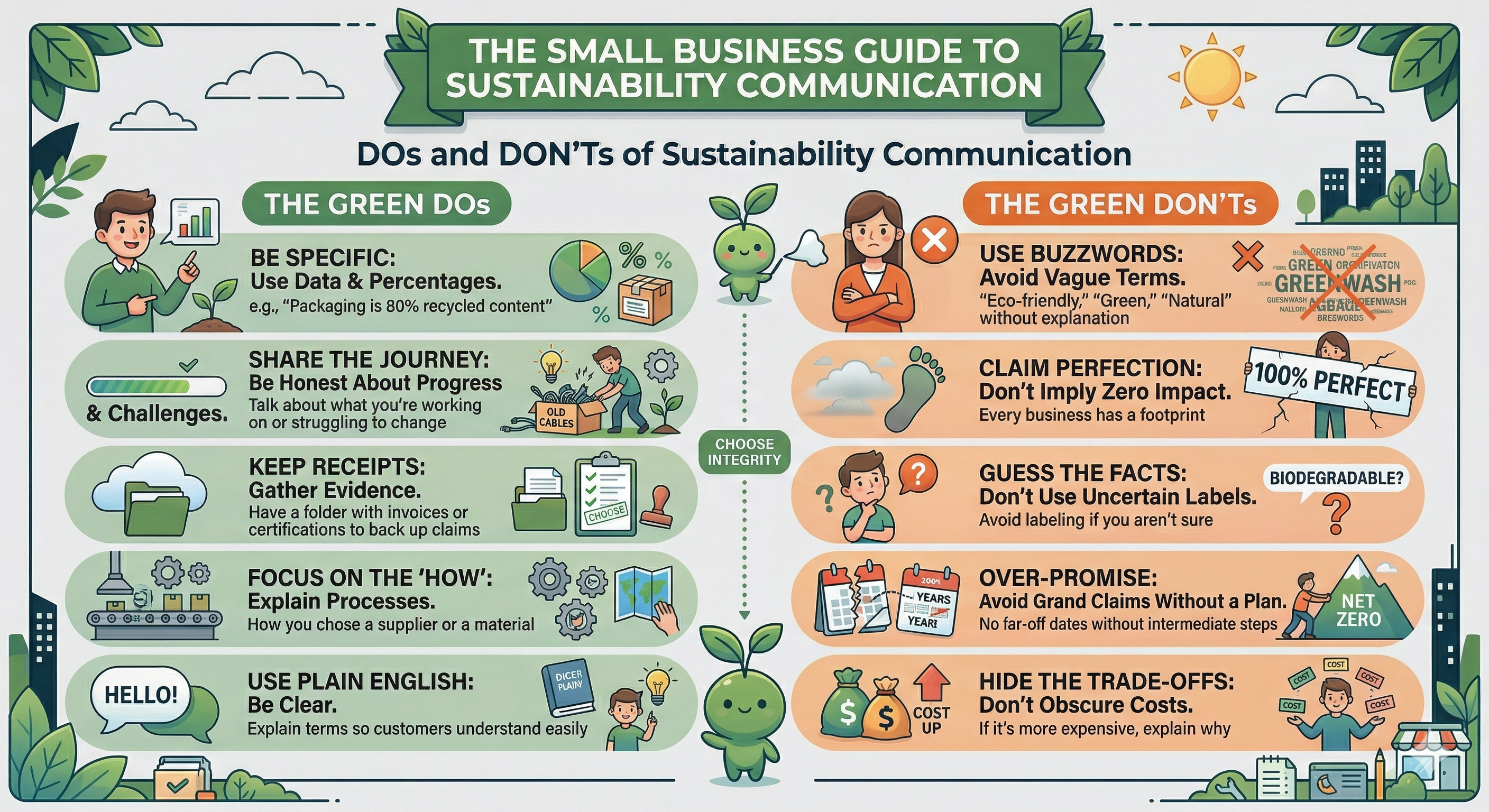
Honest progress beats perfect silence
One of the most effective things you can do is document your journey, including the parts that have not gone to plan yet.
If you still use plastic tape because the paper alternative keeps tearing during shipping, say so — and explain that you are looking for a better option. Customers do not expect you to have solved everything. They do expect you not to lie.
What people respond to is the honest version:
- Here is what we have done.
- Here is what we are still working on.
- Here is why it is harder than it looks.
Consumers are no longer looking for hero brands that claim to save the world. They are looking for partner brands that are transparent about their journey.
The Responsible Edge
Every claim needs a paper trail
Good intentions do not count as compliance. Every claim needs evidence behind it. Here is what that looks like in practice:
- Recycled content claim? Keep the invoices or spec sheets from your supplier.
- Local sourcing claim? Be ready to name the producers and where they are based.
- Carbon neutral claim? Have a clear breakdown of your emissions, what you have reduced, and how the offsetting works.
You do not need to publish all of this upfront. But have it ready — regulators, journalists, and increasingly your own customers may ask.
Focus on what you actually control
You do not need to solve climate change in an Instagram caption. Focus on areas where you have direct control and real knowledge:
- Operations. What have you changed in how you run day-to-day? "We switched to a renewable energy tariff for our workspace."
- Sourcing. How do you choose your suppliers and materials? "We chose the supplier with the shortest shipping route and no single-use plastic in their delivery packaging."
- End of life. What happens to your product after the customer is done with it? "Here is exactly how to compost our packaging in your home compost bin."
This kind of specific, grounded communication is far more convincing, and far safer, than broad claims about being a "sustainable brand."
Certifications: worth it or not?
Certifications do the verification work for you — instead of asking customers to take your word for it, an independent body has checked your claims. But they are not all equal. Here are the main options worth knowing about:
-
B Corp (high commitment)
The most rigorous option. Covers workers, community, environment, and governance. Annual cost from ~€500 plus a one-time verification fee, and requires some legal changes to your company structure. -
1% for the Planet (medium commitment)
Commit to donating 1% of gross annual sales to approved environmental non-profits. Membership from ~€500, which counts toward your pledge. Globally recognised logo and network included. -
Carbon Literacy certification (good starting point)
A one-day training for you and your team. Gives a recognised certificate, builds internal knowledge, and signals commitment — even if it does not verify products. -
Green Business certification (practical for Irish SMEs)
A structured framework for managing your environmental impact, increasingly recognised by public and private sector clients. Useful if you are tendering or working with larger companies.
The right choice depends on your size, sector, and goals. But starting with a smaller, accessible option is always better than making unverified claims.
Be specific. Be honest. Share your progress and your challenges. Back up every claim with evidence. Small businesses that communicate this way are not just avoiding legal risk — they are building something more valuable: a reputation for integrity in a space full of noise.